Related distributions
Related distributions[edit]
Sums of binomials[edit]
If X ~ B(n, p) and Y ~ B(m, p) are independent binomial variables with the same probability p, then X + Y is again a binomial variable; its distribution is Z=X+Y ~ B(n+m, p):[26]
![{\begin{aligned}\operatorname {P} (Z=k)&=\sum _{i=0}^{k}\left[{\binom {n}{i}}p^{i}(1-p)^{n-i}\right]\left[{\binom {m}{k-i}}p^{k-i}(1-p)^{m-k+i}\right]\\&={\binom {n+m}{k}}p^{k}(1-p)^{n+m-k}\end{aligned}}](https://wikimedia.org/api/rest_v1/media/math/render/svg/38fc38e9a5e2c49743f45b4dab5dae6230ab2ad5)
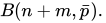
A Binomial distributed random variable X ~ B(n, p) can be considered as the sum of n Bernoulli distributed random variables. So the sum of two Binomial distributed random variable X ~ B(n, p) and Y ~ B(m, p) is equivalent to the sum of n + m Bernoulli distributed random variables, which means Z=X+Y ~ B(n+m, p). This can also be proven directly using the addition rule.
However, if X and Y do not have the same probability p, then the variance of the sum will be smaller than the variance of a binomial variable distributed as
Poisson binomial distribution[edit]
The binomial distribution is a special case of the Poisson binomial distribution, which is the distribution of a sum of n independent non-identical Bernoulli trials B(pi).[27]
Ratio of two binomial distributions[edit]
This result was first derived by Katz and coauthors in 1978.[28]
Let X ~ B(n,p1) and Y ~ B(m,p2) be independent. Let T = (X/n)/(Y/m).
Then log(T) is approximately normally distributed with mean log(p1/p2) and variance ((1/p1) − 1)/n + ((1/p2) − 1)/m.
Conditional binomials[edit]
If X ~ B(n, p) and Y | X ~ B(X, q) (the conditional distribution of Y, given X), then Y is a simple binomial random variable with distribution Y ~ B(n, pq).
For example, imagine throwing n balls to a basket UX and taking the balls that hit and throwing them to another basket UY. If p is the probability to hit UX then X ~ B(n, p) is the number of balls that hit UX. If q is the probability to hit UY then the number of balls that hit UY is Y ~ B(X, q) and therefore Y ~ B(n, pq).
Bernoulli distribution[edit]
The Bernoulli distribution is a special case of the binomial distribution, where n = 1. Symbolically, X ~ B(1, p) has the same meaning as X ~ Bernoulli(p). Conversely, any binomial distribution, B(n, p), is the distribution of the sum of n independent Bernoulli trials, Bernoulli(p), each with the same probability p.[29]
Normal approximation[edit]

If n is large enough, then the skew of the distribution is not too great. In this case a reasonable approximation to B(n, p) is given by the normal distribution

and this basic approximation can be improved in a simple way by using a suitable continuity correction. The basic approximation generally improves as n increases (at least 20) and is better when p is not near to 0 or 1.[30] Various rules of thumb may be used to decide whether n is large enough, and p is far enough from the extremes of zero or one:
- One rule[30] is that for n > 5 the normal approximation is adequate if the absolute value of the skewness is strictly less than 0.3; that is, if

This can be made precise using the Berry–Esseen theorem.
- A stronger rule states that the normal approximation is appropriate only if everything within 3 standard deviations of its mean is within the range of possible values; that is, only if
- This 3-standard-deviation rule is equivalent to the following conditions, which also imply the first rule above.


- Another commonly used rule is that both values and must be greater than or equal to 5. However, the specific number varies from source to source, and depends on how good an approximation one wants. In particular, if one uses 9 instead of 5, the rule implies the results stated in the previous paragraphs.


The following is an example of applying a continuity correction. Suppose one wishes to calculate Pr(X ≤ 8) for a binomial random variable X. If Y has a distribution given by the normal approximation, then Pr(X ≤ 8) is approximated by Pr(Y ≤ 8.5). The addition of 0.5 is the continuity correction; the uncorrected normal approximation gives considerably less accurate results.
This approximation, known as de Moivre–Laplace theorem, is a huge time-saver when undertaking calculations by hand (exact calculations with large n are very onerous); historically, it was the first use of the normal distribution, introduced in Abraham de Moivre's book The Doctrine of Chances in 1738. Nowadays, it can be seen as a consequence of the central limit theorem since B(n, p) is a sum of n independent, identically distributed Bernoulli variables with parameter p. This fact is the basis of a hypothesis test, a "proportion z-test", for the value of p using x/n, the sample proportion and estimator of p, in a common test statistic.[31]
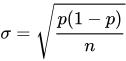
For example, suppose one randomly samples n people out of a large population and ask them whether they agree with a certain statement. The proportion of people who agree will of course depend on the sample. If groups of n people were sampled repeatedly and truly randomly, the proportions would follow an approximate normal distribution with mean equal to the true proportion p of agreement in the population and with standard deviation
Poisson approximation[edit]
The binomial distribution converges towards the Poisson distribution as the number of trials goes to infinity while the product np converges to a finite limit. Therefore, the Poisson distribution with parameter λ = np can be used as an approximation to B(n, p) of the binomial distribution if n is sufficiently large and p is sufficiently small. According to two rules of thumb, this approximation is good if n ≥ 20 and p ≤ 0.05, or if n ≥ 100 and np ≤ 10.[32]
Concerning the accuracy of Poisson approximation, see Novak,[33] ch. 4, and references therein.
Limiting distributions[edit]
- Poisson limit theorem: As n approaches ∞ and p approaches 0 with the product np held fixed, the Binomial(n, p) distribution approaches the Poisson distribution with expected value λ = np.[32]
- de Moivre–Laplace theorem: As n approaches ∞ while p remains fixed, the distribution of
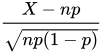
- approaches the normal distribution with expected value 0 and variance 1. This result is sometimes loosely stated by saying that the distribution of X is asymptotically normal with expected value 0 and variance 1. This result is a specific case of the central limit theorem.
Beta distribution[edit]
The binomial distribution and beta distribution are different views of the same model of repeated Bernoulli trials. The binomial distribution is the PMF of k successes given n independent events each with a probability p of success. Mathematically, when α = k + 1 and β = n − k + 1, the beta distribution and the binomial distribution are related by a factor of n + 1:

Beta distributions also provide a family of prior probability distributions for binomial distributions in Bayesian inference:[34]

Given a uniform prior, the posterior distribution for the probability of success p given n independent events with k observed successes is a beta distribution.[35]


Comments
Post a Comment