NORMED VECTOR SPACES AND INNER PRODUCT SPACES
Normed vector spaces and inner product spaces[edit]
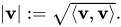
"Measuring" vectors is done by specifying a norm, a datum which measures lengths of vectors, or by an inner product, which measures angles between vectors. Norms and inner products are denoted and respectively. The datum of an inner product entails that lengths of vectors can be defined too, by defining the associated norm Vector spaces endowed with such data are known as normed vector spaces and inner product spaces, respectively.[39]


Coordinate space can be equipped with the standard dot product:










Topological vector spaces[edit]
Convergence questions are treated by considering vector spaces carrying a compatible topology, a structure that allows one to talk about elements being close to each other.[41][42] Compatible here means that addition and scalar multiplication have to be continuous maps. Roughly, if and in and in vary by a bounded amount, then so do and [nb 8] To make sense of specifying the amount a scalar changes, the field also has to carry a topology in this context; a common choice are the reals or the complex numbers.


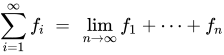
In such topological vector spaces one can consider series of vectors. The infinite sum


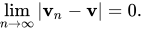
A way to ensure the existence of limits of certain infinite series is to restrict attention to spaces where any Cauchy sequence has a limit; such a vector space is called complete. Roughly, a vector space is complete provided that it contains all necessary limits. For example, the vector space of polynomials on the unit interval equipped with the topology of uniform convergence is not complete because any continuous function on can be uniformly approximated by a sequence of polynomials, by the Weierstrass approximation theorem.[43] In contrast, the space of all continuous functions on with the same topology is complete.[44] A norm gives rise to a topology by defining that a sequence of vectors converges to if and only if
![{\displaystyle [0,1],}](https://wikimedia.org/api/rest_v1/media/math/render/svg/971caee396752d8bf56711f55d2c3b1207d4a236)
![[0,1]](https://wikimedia.org/api/rest_v1/media/math/render/svg/20265bacd2212748888b178c01f3114e7f380ba4)




From a conceptual point of view, all notions related to topological vector spaces should match the topology. For example, instead of considering all linear maps (also called functionals) maps between topological vector spaces are required to be continuous.[46] In particular, the (topological) dual space consists of continuous functionals (or to ). The fundamental Hahn–Banach theorem is concerned with separating subspaces of appropriate topological vector spaces by continuous functionals.[47]


Comments
Post a Comment